Did Donald Trump's Family Ever Serve in Us Military
Trump: Americans Who Died in State of war Are 'Losers' and 'Suckers'
The president has repeatedly disparaged the intelligence of service members, and asked that wounded veterans be kept out of military parades, multiple sources tell The Atlantic .
When President Donald Trump canceled a visit to the Aisne-Marne American Cemetery nigh Paris in 2018, he blamed rain for the last-minute decision, saying that "the helicopter couldn't fly" and that the Underground Service wouldn't drive him there. Neither claim was true.
Trump rejected the idea of the visit because he feared his pilus would become disheveled in the rain, and because he did non believe it important to honor American war expressionless, according to four people with firsthand knowledge of the discussion that day. In a conversation with senior staff members on the morning of the scheduled visit, Trump said, "Why should I go to that cemetery? It'southward filled with losers." In a carve up conversation on the aforementioned trip, Trump referred to the more than 1,800 marines who lost their lives at Belleau Wood as "suckers" for getting killed.
Belleau Woods is a consequential battle in American history, and the ground on which it was fought is venerated by the Marine Corps. America and its allies stopped the German advance toward Paris at that place in the bound of 1918. But Trump, on that same trip, asked aides, "Who were the good guys in this war?" He also said that he didn't empathise why the United states of america would intervene on the side of the Allies.
Trump's understanding of concepts such as patriotism, service, and sacrifice has interested me since he expressed antipathy for the war record of the late Senator John McCain, who spent more than v years as a prisoner of the North Vietnamese. "He's not a war hero," Trump said in 2015 while running for the Republican nomination for president. "I like people who weren't captured."
There was no precedent in American politics for the expression of this sort of contempt, merely the performatively patriotic Trump did no damage to his candidacy by attacking McCain in this manner. Nor did he set his campaign back past attacking the parents of Humayun Khan, an Ground forces helm who was killed in Iraq in 2004.
Trump remained fixated on McCain, one of the few prominent Republicans to keep criticizing him later on he won the nomination. When McCain died, in August 2018, Trump told his senior staff, according to iii sources with direct cognition of this effect, "Nosotros're not going to back up that loser's funeral," and he became furious, co-ordinate to witnesses, when he saw flags lowered to half-staff. "What the fuck are we doing that for? Guy was a fucking loser," the president told aides. Trump was not invited to McCain's funeral. (These sources, and others quoted in this article, spoke on condition of anonymity. The White House did not return earlier calls for comment, just Alyssa Farah, a White House spokesperson, emailed me this argument before long afterwards this story was posted: "This report is false. President Trump holds the military in the highest regard. He's demonstrated his delivery to them at every turn: delivering on his promise to give our troops a much needed pay raise, increasing armed services spending, signing disquisitional veterans reforms, and supporting war machine spouses. This has no basis in fact.")
Trump'southward understanding of heroism has not evolved since he became president. According to sources with cognition of the president's views, he seems to genuinely non understand why Americans treat quondam prisoners of war with respect. Nor does he understand why pilots who are shot down in combat are honored by the military. On at least two occasions since becoming president, co-ordinate to three sources with direct knowledge of his views, Trump referred to former President George H. Westward. Bush as a "loser" for existence shot down past the Japanese equally a Navy pilot in World War II. (Bush escaped capture, but eight other men shot downward during the aforementioned mission were caught, tortured, and executed by Japanese soldiers.)
When lashing out at critics, Trump ofttimes reaches for illogical and corrosive insults, and members of the Bush family have publicly opposed him. But his cynicism nearly service and heroism extends even to the World War I dead buried outside Paris—people who were killed more than a quarter century before he was built-in. Trump finds the notion of military service difficult to understand, and the idea of volunteering to serve especially incomprehensible. (The president did not serve in the war machine; he received a medical deferment from the draft during the Vietnam State of war because of the declared presence of os spurs in his feet. In the 1990s, Trump said his efforts to avoid contracting sexually transmitted diseases constituted his "personal Vietnam.")
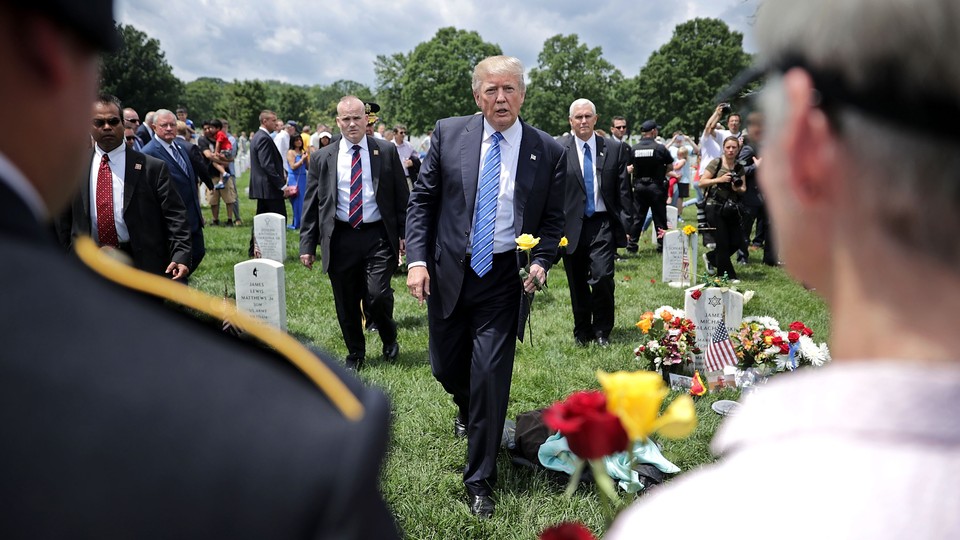
On Memorial Twenty-four hours 2017, Trump visited Arlington National Cemetery, a curt bulldoze from the White House. He was accompanied on this visit by John Kelly, who was then the secretary of homeland security, and who would, a brusk time later, be named the White Firm chief of staff. The 2 men were fix to visit Section 60, the 14-acre surface area of the cemetery that is the burial ground for those killed in America'south about recent wars. Kelly's son Robert is buried in Section 60. A first lieutenant in the Marine Corps, Robert Kelly was killed in 2010 in Afghanistan. He was 29. Trump was meant, on this visit, to join John Kelly in paying respects at his son's grave, and to comfort the families of other fallen service members. But according to sources with knowledge of this visit, Trump, while standing past Robert Kelly's grave, turned directly to his father and said, "I don't get it. What was in it for them?" Kelly (who declined to comment for this story) initially believed, people close to him said, that Trump was making a ham-handed reference to the selflessness of America's all-volunteer force. But later he came to realize that Trump simply does not sympathise non-transactional life choices.
"He can't fathom the idea of doing something for someone other than himself," one of Kelly's friends, a retired four-star full general, told me. "He merely thinks that anyone who does annihilation when there'due south no directly personal gain to be had is a sucker. In that location's no money in serving the nation." Kelly's friend went on to say, "Trump tin't imagine anyone else's pain. That'due south why he would say this to the father of a fallen marine on Memorial Day in the cemetery where he's cached."
I've asked numerous general officers over the past year for their analysis of Trump's seeming contempt for military service. They offering a number of explanations. Some of his cynicism is rooted in frustration, they say. Trump, dissimilar previous presidents, tends to believe that the military machine, like other departments of the federal government, is beholden but to him, and non the Constitution. Many senior officers accept expressed worry about Trump'southward understanding of the rules governing the use of the military. This issue came to a head in early June, during demonstrations in Washington, D.C., in response to constabulary killings of Black people. James Mattis, the retired Marine general and former secretarial assistant of defense, lambasted Trump at the time for ordering law-enforcement officers to forcibly clear protesters from Lafayette Foursquare, and for using soldiers as props: "When I joined the armed services, some 50 years agone, I swore an adjuration to support and defend the Constitution," Mattis wrote. "Never did I dream that troops taking that aforementioned oath would be ordered under any circumstance to violate the Ramble rights of their fellow citizens—much less to provide a bizarre photo op for the elected commander-in-chief, with military leadership standing alongside."
Another caption is more quotidian, and aligns with a broader understanding of Trump's textile-focused worldview. The president believes that nothing is worth doing without the promise of monetary payback, and that talented people who don't pursue riches are "losers." (According to eyewitnesses, after a White Business firm briefing given by the and so-chairman of the Joint Chiefs of Staff, General Joe Dunford, Trump turned to aides and said, "That guy is smart. Why did he join the military?")
Yet another, related, explanation concerns what appears to be Trump's pathological fear of actualization to look like a "sucker" himself. His capacious definition of sucker includes those who lose their lives in service to their state, as well every bit those who are taken prisoner, or are wounded in battle. "He has a lot of fear," i officer with firsthand knowledge of Trump'due south views said. "He doesn't see the heroism in fighting." Several observers told me that Trump is securely anxious well-nigh dying or being disfigured, and this worry manifests itself as disgust for those who have suffered. Trump recently claimed that he has received the bodies of slain service members "many, many" times, but in fact he has traveled to Dover Air Force Base, the transfer point for the remains of fallen service members, just four times since becoming president. In another incident, Trump falsely claimed that he had called "virtually all" of the families of service members who had died during his term, so began rush-shipping condolence letters when families said the president was not telling the truth.
Trump has been, for the duration of his presidency, fixated on staging military parades, but merely of a sure sort. In a 2018 White House planning coming together for such an upshot, Trump asked his staff not to include wounded veterans, on grounds that spectators would feel uncomfortable in the presence of amputees. "Nobody wants to see that," he said.
Source: https://www.theatlantic.com/politics/archive/2020/09/trump-americans-who-died-at-war-are-losers-and-suckers/615997/
0 Response to "Did Donald Trump's Family Ever Serve in Us Military"
ارسال یک نظر